|
|
- Spacey and forgetful
- Easily distracted
- Difficulty with turn taking
- Doesn’t turn in assignments
- Fidgets/squirms in seat or doesn’t stay in seat
- Interrupts conversations
- Loses things
- Low frustration tolerance
- Off topic
- Talks excessively
|
- Careless mistakes on school work
- Difficulty following directions
- Does not follow through with directions/tasks
- Doesn’t complete assignments
- Erratic memory
- Fails to give close attention to school work
- Has inconsistent performance in school
- Can’t keep up with rest of the class
|
(These assessments are used to look at attention impacts secondary to brain injury, not to diagnose ADHD/ADD.)
- A Developmental Neuropsychological Assessment, 2nd (NEPSY-II): Auditory Attention and Auditory Attention Response Set
- Cognitive Assessment System, 2nd (CAS2): Attention Scale (Consider Planning Scale)
- Wechsler Intelligence Scale for Children, 5th (WISC-V): Cancellation, Symbol Search, Coding, Working Memory Index and Auditory Working Memory Index
- Differential Ability Scale, 2nd (DAS-II): Working Memory Composite
- Woodcock Johnson, 4th (WJ-IV) Tests of Cognitive Abilities: Verbal Attention, Numbers Reversed, Object-Number Sequencing, Pair Cancellation, Letter-Pattern Matching
- Conners Continuous Performance Test, 3rd (CPT3)
- Auditory Continuous Performance Test
- Tasks of Executive Control (TEC)
- Test of Everyday Attention for Children (TEA-CH)
- Behavior Assessment System for Children, 3rd (BASC-3)
- Behavior Rating Inventory of Executive Function, 2nd (BRIEF-2): Working Memory (examine specific items)
- Comprehensive Executive Function Inventory (CEFI)
- Delis Rating of Executive Function (D-REF)
- Conners, 3rd
- Vanderbilt Teacher Behavior Evaluation Scale (VTBES)
- Behavioral Observations of Students in Schools (BOSS)
- Neurocognitive Evaluation Form in Appendix, Colorado Department of Education Brain Injury in Children and Youth: A Manual for Educators
- Classroom Observations On Task/Off Task Peer Analyses
- Behavior observations during testing
- Parent, Teacher and Student Interviews
|
- Brain Injury in Children and Youth: A Manual for Educators (Chapter 3) (CDE)
- Directly teach and practice what paying attention looks like
- Teach self-monitoring
- Brain Breaks
- Vigorous exercise
- Mindfulness, meditation, relaxation techniques, yoga
- Ensure that you have the child’s focus prior to giving instructions
- Frequent check-ins and redirection
- Reduce visual and auditory distractions
- Clear desk of everything except what is needed for the lesson
- Seat child closest to point of instruction and away from distractions
- Verbal and visual cues (cue word, nonverbal gesture, sticky note system, stop light system)
- Behavior Intervention Plan
|
|
|
|
- Acts on first thing that pops into their mind
- Blurts thoughts out and can talk excessively
- Calling out rather than waiting with hand raised
- Fidgety/squirmy
- Difficulty staying in line, seat, classroom, etc.
- Impulsive; “jumps before looks”
- Interrupts; socially intrusive
- Jumps into an activity rather than waiting for/reading instructions
- Physical touch with others may be too much
- Disregard for boundaries
- Social Difficulties
- Participating in unsafe behaviors or behaviors that get them into trouble
|
- Can be disruptive in the classroom
- Difficulty following multistep directions
- Not slowing down to process directions
- May complete assignments incorrectly
- May require a lot of redirection from teacher
|
- A Developmental Neuropsychological Assessment, 2nd (NEPSY-II): Inhibition, Statue, Auditory Attention and Response Set
- Delis-Kaplan Executive Function System (D-KEFS): Trail Making, Color Word Interference, Design Fluency, Sorting, Tower, 20 Questions
- Cognitive Assessment System, 2nd (CAS-2): Attention Scale
- Woodcock Johnson, 4th (WJ-IV) Tests of Cognitive Abilities: Pair Cancellation
- Wechsler Intelligence Scale for Children, 5th (WISC-V): Matrix Reasoning (quickly responds without considering options or quickly responds and then immediately changes answer)
- Differential Ability Scales, 2nd (DAS-II): Matrices (quickly responds without considering options or quickly responds and then immediately changes answer)
- Kaufman Assessment Battery for Children, 2nd, (KABC-II): Riddles
- Conners Continuous Performance Test, 3rd (CPT3): Response Speed, Commission Errors, Perseverations
- Test of Everyday Attention for Children (TEA-Ch)
- Stroop Color-Word Interference
- Behavior Assessment System for Children, 3rd (BASC-3): Hyperactivity Scale
- Conners, 3rd: Hyperactivity/Impulsivity Scale
- Behavior Rating Inventory of Executive Function, 2nd (BRIEF2)
- Comprehensive Executive Function Inventory (CEFI)
- Delis Rating of Executive Function (D-REF)
- Observations in the environment
- Functional Behavioral Assessment Behavior observations during testing (jump right in or thoughtful about responses/approach)
- Parent, Teacher and Student Interviews
|
|
- Brain Injury in Children and Youth: A Manual for Educators (Chapter 3) (CDE)
- Executive Function in Children and Adolescents, 2nd (Dawson/Guare)
- Lost at School (Greene)
- Promoting Executive Function in the Classroom (Meltzer)
- Smart but Scattered (Dawson/Guare)
- Smart but Scattered Teens (Guare/ Dawson/Guare)
- Alert Program: How Does Your Engine Run (Williams/Shellenberger)
- The Incredible 5 Point Scale (Buron/Curtis)
- Project Achieve – Stop & Think Program (Knoff)
- Project Success (Kastner)
- Superflex: A Superhero Social Thinking Curriculum (Madrigal/Winner)
- Zones of Regulation (Kuper)
|
|
|
- Acts like he doesn’t understand
- Appears inattentive
- Delay in response
- Fatigues easily
- Frustration
|
- Delay in response
- Difficulty following lecture
- Difficulty multi-tasking
- Spotty learning of new information
- Difficulty taking timed tests
- Does not appear to remember information
- Incomplete work
- Poor grades in-spite good effort
- Slow at doing work
|
- Wechsler Intelligence Scale for Children, 5th (WISC-V): Processing Speed Index, Cancellation
- Differential Ability Scales, 2nd (DAS-II): Processing Speed Composite
- Woodcock Johnson, 4th (WJ-IV) Tests of Cognitive Abilities: Letter-Pattern Matching, Pair Cancellation
- Cognitive Assessment System, 2nd (CAS2): Planning Index
- Task of Executive Control (TEC)
- Neurocognitive Evaluation Form in Appendix, Colorado Department of Education Brain Injury in Children and Youth: A Manual for Educators
- Observations in the environment
- Behavior observations during testing
- Parent, Teacher and Student Interviews
|
- Brain Injury in Children and Youth: A Manual for Educators (Chapter 3) (CDE)
- Establish daily routines and classroom expectations
- Allow for delay in response
- Copies of notes and outlines
- Extra time
- Give clear and concise instructions one at a time
- Repeat instructions
- Provide written instructions
- Combine visual and verbal information
- Limit number of tasks required to complete at one time
|
|
|
|
Make a differential distinction between memory problems and New Learning
- Appears manipulative
- Appears to have attitude issues
- Can’t remember more than one thing at a time
- Disorganized
- Doesn’t remember recent events
- Forgets to turn in assignments
- Gets lost frequently and easily
- Learned helplessness
- Looks spacey
- Repeatedly asks the same question
|
- Can’t re-tell a story
- Difficulty retaining new skills
- Difficulty with multi-step directions/multi-step problem
- Difficulty with spelling
- Fails test in spite of studying
- Forgets assignment
- Forgets events
- Forgets people and names
- Inconsistent performance
- Splintered learning
- State dependent learning
|
- A Developmental Neuropsychological Assessment, 2nd (NEPSY-II): Memory and Learning Subtests
- Woodcock Johnson, 4th (WJ-IV), Test of Cognitive Abilities: Verbal Attention, Numbers Reversed, Object Number Sequencing, Nonword Repetition, Memory for Words, Story Recall, Picture Recognition, Visual-Auditory Learning, Sentence Repetition (Oral Language Battery)
- Wechsler Intelligence Scale for Children, 5th (WISC-V): Working Memory and Auditory Working Memory Indexes, Arithmetic, Matrix Reasoning (later items)
- Differential Ability Scales, 2nd (DAS-II): Working Memory Composite, Recall of Objects Immediate and Delayed, Recall of Digits Forward, Recognition of Pictures, Recall of Designs, Matrices (later items)
- Kaufman Assessment Battery for Children, 2nd, (KABC-II): Sequential Processing Ability Scale
- Delis-Kaplan Executive Function System (D-KEFS): Sorting
- Child and Adolescent Memory Profile (ChAMP)
- Children’s Memory Scale (CMS)
- Test of Memory and Learning, 2nd (TOMAL-2)
- Wide Range Assessment Memory and Learning, 2nd (WRAML2)
- California Verbal Learning Test, 2nd (CVTL-II)
- California Verbal Learning Test-Children’s Version (CTVL-C)
- Test of Visual Processing Skills, 3rd (TVPS3): Visual Memory & Visual Sequential Memory
- Behavior Rating Inventory of Executive Function, 2nd (BRIEF2)
- Comprehensive Executive Function Inventory (CEFI)
- Delis Rating of Executive Function (D-REF)
- Neurocognitive Evaluation Form in Appendix, Colorado Department of Education Brain Injury in Children and Youth: A Manual for Educators
- Behavior observations during testing (can only remember first or last parts of directions or stimulus materials)
- Observations in the environment
- Parent, Teacher and Student Interviews
|
- Brain Injury in Children and Youth: A Manual for Educators (Chapter 3) (CDE)
- Encourage to develop visual picture of what have learned or read
- Teach concept and have them teach others
- Experiential Learning
- Have student paraphrase directions or steps
- Mnemonic strategies
- New concepts – engage background knowledge
- Errorless learning
- Pictures or visual cues
- Provide copies of notes
- Practice daily routines
- “Priming the pump” – slightly elevate emotions when teaching new concepts
- Use memory aids e.g. visual cues, planners, PDAs or other compensatory strategies
- Use of competitive games
- See New Learning Building Block
|
|
|
|
- Always touching people or things
- Appears overwhelmed
- Behavior may appear oppositional however, it may be adaptive; e.g. wearing hat to cover eyes, laying on the floor
- Bumps into others when in line
- Clothes are disheveled due to tugging and sucking on clothes
- Emotionally melt down
- Fidgety
- Irritable, short fuse
- Overly excited in stimulating environments such as the playground, PE, lunchroom, etc.
- Seeks oral stimulation
- Seeks physical feedback, e.g. leans on desk
- Tunes out due to over stimulation
|
- Difficulty completing worksheets with too many items on them
- Difficulty shifting from workbook/textbook to writing on answer sheet/paper
- Difficulty transitioning
- Difficulty with group work and group discussion
- Difficulty with reading due to visual stimuli
- Difficulty with seat work
- Excessive erasing, crossing out of words
- Gets overwhelmed in crowded environments
- Incomplete work
- Messy papers, school work is not well-organized
- Poor handwriting
|
- Sensory Profile-2
- Sensory Processing Measure (SPM)
- Sensory Processing Measure Preschool (SPM-P)
- Sensory Integration Inventory
- Degangi-Berk Test of Sensory Integration (TSI)
- Dean-Woodcock Sensory Motor Battery
- A Developmental Neuropsychological Assessment, 2nd (NEPSY-II): Sensorimotor Subtests
- Effective informal vision – ocular motor control
- Functional Vision Assessment
- Neurocognitive Evaluation Form in Appendix, Colorado Department of Education Brain Injury in Children and Youth: A Manual for Educators
- Vision and hearing screening: conversion/tracking/depth perception
- Observations in the environment
- Functional Behavioral Assessment Behavior observations during testing
- Parent, Teacher and Student Interviews
|
- Brain Injury in Children and Youth: A Manual for Educators (Chapter 3) (CDE)
- Occupational Therapist and/or Physical Therapist Consult
- Allow student to dictate first draft of written assignment rather than write
- Allow student to use a computer for written work
- Reduce number of problems on a page
- Break down written work into chunks
- Deep joint pressure
- Preferential and thoughtful seating to reduce auditory and visual stimulation
- Preferential seating to decrease sensory input
- Reduce visual and auditory distractions
- Situation modification: earplugs, sunglasses, visors, moving to a new location
- Situation selection: tune into preferential sound, mindfulness, goal orientation, diaphragmatic breathing
- Use color overlays
- Use line ruler to assist with visual tracking
- Use study carrel
- Weighted vests/ items (blankets, animals)
- Wiggle Seat/inflatable chair cushion/ dynamic seating systems
- Conduct assistive technology evaluation
|
|
|
|
- Motor – can appear clumsy and run into objects/people
- Motor – constantly on the move
- Tactile – seeks out touch or being held
- Takes a lot of sensation to stimulate the child – so they seek out more stimulation
- Taste – picky eaters
|
- Difficulty following verbal directions
- Tactile – difficulty registering pain or pressure
|
- Sensory Profile-2
- Sensory Processing Measure (SPM)
- Sensory Processing Measure Preschool (SPM-P)
- Sensory Integration Inventory
- Degangi-Berk Test of Sensory Integration (TSI)
- Dean-Woodcock Sensory Motor Battery
- A Developmental Neuropsychological Assessment, 2nd (NEPSY-II): Sensorimotor Subtests
- Effective informal vision – ocular motor control
- Functional Vision Assessment
- Neurocognitive Evaluation Form in Appendix, Colorado Department of Education Brain Injury in Children and Youth: A Manual for Educators
- Vision and hearing screening: conversion/tracking/depth perception
- Observations in the environment
- Functional Behavioral Assessment Behavior observations during testing
- Parent, Teacher and Student Interviews
|
- Brain Injury in Children and Youth: A Manual for Educators (Chapter 3) (CDE)
- Occupational Therapist and/or Physical Therapist Consult
- Allow them to chew gum, hard candy, or crunchy foods
- Fidget items
- Heavy work or deep pressure activities
- Running or jumping
- Stretch bands on chairs
- Therapy seats/exercise balls for sitting
- Therapy swings or swinging
- Trampoline
- Wall push-ups
|
|
|
|
- Difficulty with fasteners
- Shaky hands/tremors
- Poor coordination
|
- Avoids tasks involving writing
- Difficulty with cutting
- Difficulty with drawing
- Poor handwriting
- Takes long time to produce written work
- Messy work
|
- Beery-Buktenica Developmental Test of Visual Motor Integration, 6th (BEERY VMI)
- Bruininks-Oseretsky Test of Motor Proficiency, 2nd (BOT-2)
- Bender Visual-Motor Gestalt Test, 2nd
- Evaluation of Children’s Handwriting Skills – Grades 1-6 (ETCH)
- Test of Handwriting Skills-Revised (THS-R)
- Schooldles School Fine Motor Assessment, 4th (SFMA-4)
- Peabody Developmental Motor Skills, 2nd (PDMS-2)
- Test of Visual Motor Skills, 3rd (TVMS-3)
- Preschool Visual Motor Integration Assessment (PVMIA)
- Developmental Test of Visual Perception, 3rd (DTVP-3)
- Wide Range Assessment of Visual Motor Abilities (WRAVMA)
- Slosson Visual-Motor Performance Test (S-VMPT)
- A Developmental Neuropsychological Assessment, 2nd (NEPSY-II): Sensorimotor Subtests
- Dean-Woodcock Sensory Motor Battery
- Differential Ability Scales, 2nd (DAS-II), Recall of Designs
- Neurocognitive Evaluation Form in Appendix, Colorado Department of Education Brain Injury in Children and Youth: A Manual for Educators
- Observations in the environment
- Observations during testing
- Parent, Teacher and Student Interviews
|
- Brain Injury in Children and Youth: A Manual for Educators (Chapter 3) (CDE)
- Occupational Therapist and/or Physical Therapist Consult
- Assistive/Adaptive Technology
- Adapted scissors
- Allow student to use computer for written work
- Develop pre-prepared materials so that they do not have to focus on cutting etc. but can focus on content
- Guided notes/outline
- Pencil grips
- Slant boards
- Speech to text technology
- Typing/texting vs. writing
|
|
|
|
- Avoids sports
- Bumps into things
- Difficulties carrying lunch tray
- Clumsy
- Falls/Stumbles
- Unsteady on stairs, playground equipment or in crowds
|
- Avoids recess
- Difficulty with or avoidance of P.E.
- Slumps in seat
|
- School Functional Assessment (SFA)
- Test of Gross Motor Development, 2nd (TGMD-2)
- Peabody Developmental Motor Scales, 2nd (PDMS-2)
- Bruininks-Oseretsky Test of Motor Proficiency, 2nd (BOT-2)
- Peabody Developmental Motor Skills, 2nd (PDMS-2), for birth to 2 yr
- Dean-Woodcock Sensory Motor Battery
- Neurocognitive Evaluation Form in Appendix, Colorado Department of Education Brain Injury in Children and Youth: A Manual for Educators
- Observations in the environment
- Parent, Teacher and Student Interviews
|
- Brain Injury in Children and Youth: A Manual for Educators (Chapter 3) (CDE)
- Occupational Therapist and/or Physical Therapist Consult
- Adapted sports and physical education class
- Adapted seating (chairs, desks)
- Heavy work activities-e.g. standing wall pushups, carrying books, stacking chairs, etc.
|
|
|
|
Make a differential distinction between New Learning and Memory problem
- Easily frustrated or overwhelmed
- Angry outbursts or meltdowns
- Can be misclassified as lazy
- Can seem defiant
- Copies others’ behavior or work
- Follower
- Forgetful
- Makes things up to save face
- May not exert effort when new material is presented
- Spacey
|
- Cannot generalize or over generalizes information
- Does not remember information they have been taught
- Fails to see big picture
- Forgets people and names
- Inconsistent performance day to day
- May be able to memorize but cannot apply information
- Poor result in spite of extensive effort
- Splintered or Uneven learning
|
- A Developmental Neuropsychological Assessment, 2nd (NEPSY-II): Memory and Learning- Immediate Trials
- Differential Ability Scales, 2nd (DAS-II): Recall of Objects-Immediate Trials
- Kaufman Assessment Battery for Children, 2nd, (KABC-II): Learning Ability Scale
- Woodcock Johnson, 4th (WJ-IV): Test of Cognitive Abilities: Story Recall, Visual Auditory Learning
- Test of Memory and Learning, 2nd, (TOMAL-2): New Learning Index
- Wide Range Assessment Memory and Learning, 2nd (WRAML2)
- Wechsler Memory Scales, 3rd (WMS-III)
- Children’s Memory Scales (CMS)
- California Verbal Learning Test, 2nd (CVTL-II)
- California Verbal Learning Test-Children’s Version (CTVL-C)
- Clinical Evaluation of Language Fundamentals, 4th (CELF-4): Paragraph Recall Subtest
- Scales of Cognitive Ability for Traumatic Brain Injury (SCATBI) for Adolescents
- Observations in the environment
- Behavior observations during testing
- Parent, Teacher and Student Interviews
|
|
|
|
|
- Acts out
- Confused
- Difficulty with auditory information
- Does not understand multiple meaning words, inferential, figurative and more complicated abstract language
- Echolalia
- Follower
- Inability to follow multi-step directions
- Inattentive, distractible
- Says “huh” frequently
- Slow or does not respond to directions
- Social withdrawal
|
- Difficulty understanding complex ideas or direction
- Answers wrong question
- Circumlocution
- Delayed reading
- Difficulty following instructions
- Difficulty problem solving
- Difficulty understanding homework assignments
- Difficulty with math word problems
- Poor reading comprehension
- Reading or writing weakness
- Slow to understand
- Writing output is weak
|
- Clinical Evaluation of Language Fundamentals-Preschool, 2nd (CELF-Preschool-2)
- Clinical Evaluation of Language Fundamentals, 5th (CELF-5): Receptive Language Index
- Comprehensive Assessment of Spoken Language, 2nd (CASL-2)
- Listening Test
- Oral and Written Language Scales, 2nd (OWLS-II)
- Peabody Picture Vocabulary Test, 4th (PPVT-4)
- Preschool Language Scales, 5th (PLS-5)
- Test of Language Competence, Expanded Edition (TLC-E)
- Test of Problem Solving, 2nd Adolescent (TOPS-2)
- Test of Problem Solving, 3rd Elementary (TOPS-3)
- Observations in the environment
- Observations during testing
- Parent, Teacher and Student Interviews
|
- Brain Injury in Children and Youth: A Manual for Educators (Chapter 3) (CDE)
- Speech Language Pathologist Consult
- Allow extra “think” time
- Break complex directions into concrete examples
- Give directions slowly and one at a time
- Have child repeat back instructions
- Provide directions, assignments, lectures in writing
- Reduce semantic load to minimize frustration and confusion
- Reinforce with visual cues
- Teach the use of graphic organizers to visually represent concepts
- Identify target vocabulary and integrate throughout lessons
|
|
|
|
- Word retrieval difficulty using words and sentences to express ideas
- Uses poor grammar or immature speech
- Breakdown in logical sequencing of ideas
- Circumlocution
- Difficult to follow in conversations
- Difficulty interpreting sarcasm
- Dysarthric speech (slow, slurred speech, mumbling)
- Frequently repeat the same question or make the same comment
- Act out
- Follower
- Frustration
- Ruminating on topics
- Social withdrawal
|
- Difficulty identifying or providing salient details
- Difficulty summarizing
- Difficulty with problem-solving
- Lack of specific language in academic work
- Often repeats the same idea rather than providing more or different information about a topic
- Responses may be short without much elaboration on topic
- Trouble participating in class discussions
- Trouble writing essay questions or re-telling stories
|
- Clinical Evaluation of Language Fundamentals, 5th (CELF-5): Expressive Language Index
- Clinical Evaluation of Language Fundamentals-Preschool, 2nd (CELF-Preschool-2)
- Comprehensive Assessment of Spoken Language, 2nd (CASL-2)
- Expressive One-Word Picture Vocabulary Test, 4th (EOWPVT-4)
- Functional Communication Measures (FCM)
- Oral and Written Language Scales, 2nd (OWLS-II)
- Preschool Language Scales, 5th (PLS-5)
- Wechsler Intelligence Scale for Children, 5th (WISC-V): Verbal Comprehension Index
- Differential Ability Scales, 2nd (DAS-II): Verbal Composite
- Kaufman Assessment Battery for Children, 2nd (KABC-II): Knowledge Ability Scales
- Woodcock Johnson, 4TH (WJ-IV): Oral Vocabulary
- A Developmental Neuropsychological Assessment, 2nd (NEPSY-II): Language Subtests
- Wechsler Individual Achievement Test, 3RD Ed. (WIAT-3): Oral Expression
|
- Brain Injury in Children and Youth: A Manual for Educators (Chapter 3) (CDE)
- Speech Language Pathologist Consult
- Allow child to dictate thoughts prior to writing
- Ask open-ended questions
- Provide choices
- Teach attributes of concepts
- Teach summarization skills
- Teach the child appropriate expressions, role play
- Allow plenty of time for responses and do not pressure the child
|
|
|
|
- Difficulty building or maintaining friendships
- Difficulty negotiating social rules
- Difficulty staying on topic
- Difficulty taking turns
- Difficulty understanding humor, jokes or sarcasm
- Difficulty with proprioception (knowing body in space)
- Difficulty responding to facial expressions and body language
- Frustration
- Inappropriate use of jokes, sarcasm or humor
- Inappropriate tone of voice
|
- Difficulty making and maintaining friendships
- Difficulty working in groups in the classroom
- Doesn’t seem to fit into social groups in less structured settings such as recess, lunch, etc.
|
- Clinical Evaluation of Language Fundamentals, 5th (CELF-5)
- Conversational Effectiveness Profile–Revised (CEP-R); http://www.socialpragmatics.com/publications.html
- Social Language Development Test, Elementary or Adolescent
- Test of Problem Solving, 2nd Ed Adolescent (TOPS-2)
- Test of Problem Solving, 3rd Ed Elementary (TOPS-3)
- Test of Pragmatic Language, 2nd (TOPL-2)
- Children’s Communication Checklist, 2nd (CCC-2)
- Social Emotional Evaluation (SEE)
- Social Language Development Test-Elementary or Adolescents
- A Developmental Neuropsychological Assessment, 2nd (NEPSY-II): Social Perception Subtests
- Observations in the environment
- Parent, Teacher and Student Interviews
|
- Brain Injury in Children and Youth: A Manual for Educators (Chapter 3 and 4) (CDE)
- Develop friendship groups
- Consider students place with for partner/group work
- Model and role play social interactions
- Social narratives
- Teach social problem solving skills
- See Social/Emotional Competency Building Block
|
- Brain Injury in Children and Youth: A Manual for Educators (Chapter 3) (CDE)
- Social Language Development Scenes (Elementary/ Adolescent) (Linguisystems)
- Social Thinking Worksheets for Tweens and Teens (Winner)
- Superflex: A Superhero Social Thinking Curriculum (Winner)
- You are a Social Detective (Winner)
- American Speech Language Hearing Association http://www.asha.org
- See Interventions in Social/Emotional Competency Section
|
|
|
- Can experience behavior issues due to frustration of not understanding visual materials and expectations
- Appears overwhelmed
- Struggles reading social cues or facial expressions
- Complains that “it all blends together”
- Difficulty organizing materials
- Difficulty with proprioception (knowing body in space)
- Gets lost
- Increased headaches during visual tasks
- Sensitivity to light
|
- Depth perception issues
- Difficulty organizing written work
- Difficulty using charts, maps, and graphs
- Difficulty with Mathematics/Geometry
- Distance perception difficulty
- Handwriting issues
- Struggles with mental rotation and object construction
- Reading difficulty
- Spatial perception and orientation difficulty
- Issues visualizing mental maps
|
- A Developmental Neuropsychological Assessment, 2nd (NEPSY-II): Visualspatial Processing Subtests
- Wechsler Intelligence Scale for Children, 5th (WISC-V): Visual Spatial Index, Fluid Reasoning Index, Picture Concepts
- Woodcock Johnson, 4th (WJ-IV), Cognitive: Visualization, Picture Recognition
- Differential Ability Scales, 2nd (DAS-II): Spatial Composite
- Kauffman Assessment Battery for Children (KABC-II): Simultaneous Processing Ability Scale
- Beery-Buktenica Developmental Test of Visual Motor Integration, 6th (BEERY VMI)
- Leiter International Performance Scale, 3rd (Leiter-3)
- Test of Visual Perceptual Skills, 3rd Ed. (TVPS-3)
|
- Brain Injury in Children and Youth: A Manual for Educators (Chapter 3) (CDE)
- Consider if visual presentation of worksheets needs to be modified
- Enlarge written materials
- Provide directions verbally
- Frequent checks for understanding
- Provide support in aligning math problems (graph paper)
- Provide support in organizing writing from left to right and organizing/expressing thoughts
- Reduce visual “clutter” at student’s desk
- Use a ruler/straight edge to track reading
- Verbal focus on learning
- Visual planners (webs, diagrams) may be too confusing
|
|
|
|
- Difficulty starting tasks independently
- Can state what they are supposed to do but does not get started
- Slow to shift at same time as peers
- Requires constant cueing
- Does not make plans academically or socially
- Appears aloof or disinterested in peers
- Follower
- Lagging in independent living skills
- May appear lazy, unmotivated or spacey
- Often gets overlooked because they are not trouble in the classroom
- Seeks out adults for social interaction
|
- Appears passive/resistant
- Difficulty knowing how to get started
- Difficulty managing long-range projects
- Does not complete homework or seatwork
- Turns in poor quality work
- Woefully incomplete work
|
- Behavior Rating Inventory of Executive Function, 2nd (BRIEF2)
- Comprehensive Executive Function Inventory (CEFI)
- Delis Rating of Executive Function (D-REF)
- Neurocognitive Evaluation Form in Appendix, Colorado Department of Education Brain Injury in Children and Youth: A Manual for Educators
- Observations in the environment
- Behavior observations during testing
- Parent, Teacher and Student Interviews
|
- Brain Injury in Children and Youth: A Manual for Educators (Chapter 3) (CDE)
- Provide a written routine to assist/help student begin work
- Provide assistance with getting started with school work
- Provide more frequent check-ins to ensure student is completing work
- Teach students how to observe others to identify what to do next
- Use visual imagery to practice the activity steps prior to initiation
- May need friendship groups or support initiating social interactions
- See Planning and Organization Building Blocks
|
|
|
|
- Difficulty with problem solving
- Doesn’t make plans with friends
- Rigidity of thinking
- Often late for class
- Often unprepared for class
|
- Difficulty organizing thoughts
- Difficulty with long term assignments
- Difficulty with sequential tasks
- Difficulty with time management
- Difficulty writing papers
- Doesn’t brainstorm
|
- Cognitive Assessment System, 2nd (CAS2): Planning Scale
- Kaufman Assessment Battery for Children, 2nd: Planning Ability Scale
- A Developmental Neuropsychological Assessment, 2nd (NEPSY-II): Attention and Executive Function Subtests
- Wechsler Intelligence Scale for Children, 5th (WISC-V): Block Design
- Differential Ability Scale, 2nd (DAS-2): Recall of Designs and Block Design
- Behavior Rating Inventory of Executive Function, 2nd (BRIEF2)
- Comprehensive Executive Function Inventory (CEFI)
- Delis Rating of Executive Function (D-REF)
- Delis-Kaplan Executive Function System (D-KEFS): Tower Test
- Trails Making (A&B)
- Rey-Osterrieth Complex Figure
- Neurocognitive Evaluation Form in Appendix, Colorado Department of Education Brain Injury in Children and Youth: A Manual for Educators
- Observations in the environment
- Behavior observations during testing
- Parent, Teacher and Student Interviews
|
|
|
|
|
- Seems confused
- Copies behaviors of others
- Difficulty with transitions
- Easily frustrated
- Resistant
- Follower
- Is disorganized
- Loses things easily
- Spacey
- Conversations may be disjointed
|
- Difficulty with long range projects
- Unable to do more than one step on a task
- Doesn’t turn in homework
- Homework is incomplete
- Not independent learner
- Often forgetful
- Work is messy
- Difficulties answering open-ended questions
|
- Behavior Rating Inventory of Executive Function, 2nd (BRIEF2): Organization of Materials and Planning/Organization Scale (look at specific items)
- Comprehensive Executive Function Inventory (CEFI)
- Neurocognitive Evaluation Form in Appendix, Colorado Department of Education Brain Injury in Children and Youth: A Manual for Educators
- Observations in the environment
- Behavior observations during testing
- Parent, Teacher and Student Interviews
|
- Brain Injury in Children and Youth: A Manual for Educators (Chapter 3) (CDE)
- Establish daily routine
- Check in/Check out system
- Color code subjects
- Provide student with step-by-step instructions
- Report and Talk Aloud strategy
- Smartphone apps: clock/timer, calendar with reminders, Evernote recordings/pictures/detailed instruction
- Use of classroom websites with posted notes and assignments
- Multiple small storage bins; label storage area contents – create routines for use
- Support between home and school to implement an organization system
- Teach/support organization skills/systems (folders, planners, etc.)
- Use of graphic organizers
- Use a “zipper” folder containing sections for each subject and sections for work “to do”, “completed” etc.
- Teach goal-directed problem solving process; Goal-Plan-Do-Review
- See Initiation and Planning Building Blocks
|
|
|
|
- Argumentative
- Concrete thinker
- Rigid thinker
- Perseveration
- Difficulty making friends
- Difficulty taking feedback
- Difficulty with transitions
- Doesn’t like to try new things
- Lacks empathy
- Stubborn
- Issues with understanding the perspective of others
|
- Difficulty coming up with solutions
- Difficulty deviating from schedule
- Difficulty shifting between tasks or ideas
- Difficulty with abstract thinking
- Doesn’t do what asked
- Doesn’t learn from mistakes
- Doesn’t think well on his/her feet
|
- A Developmental Neuropsychological Assessment, 2nd (NEPSY-II): Attention and Executive Function Subtests
- Wechsler Intelligence Scale for Children, 5th (WISC-V): Picture Concepts, Matrix Reasoning, Comprehension (questions requiring multiple responses)
- Differential Ability Scale, 2nd (DAS-2): Matrices
- Woodcock Johnson, 4th (WJ-IV) Test of Cognitive Abilities: Concept Formation
- Delis-Kaplan Executive Function System (D-KEFS): Sorting, Trail Making, Verbal Fluency, Design Fluency, Color-Word Interference, Tower
- Wisconsin Card Sort Test
- Children’s Category Test
- Behavior Rating Inventory of Executive Function, 2nd (BRIEF2): Shift Scale
- Comprehensive Executive Function Inventory (CEFI): Flexibility Scale
- Neurocognitive Evaluation Form in Appendix, Colorado Department of Education Brain Injury in Children and Youth: A Manual for Educators
- Observations in the environment
- Functional Behavioral Assessment
- Behavior observations during testing
- Parent, Teacher and Student Interviews
|
- Brain Injury in Children and Youth: A Manual for Educators (Chapter 3) (CDE)
- Develop, teach and reinforce routines
- Block & Box (Sarah Ward)
- Explicitly teach flexible thinking skills (i.e., warnings, counting down time, timers, practice changing schedule)
- Guided Self-Reflection
- Plan for situations that require mental flexibility
- Teach Stop, Relax and Think
- Teach coping strategies, belly breathing, mindfulness, meditation, relaxation techniques
- Social skills groups. Teach perspective taking
- Use of social narratives
- See Reasoning and Social/Emotional Competency Building Blocks
|
|
|
|
- Acts without thinking of the consequences
- Does not follow through with request to complete tasks
- Doesn’t think well on his/her feet
- Followers
- Lacks common sense
- Makes poor behavioral and social choices
- May appear depressed
- Oppositional
- Poor social judgment and risk taking behaviors e.g. promiscuity, school suspension
- Argumentative
- Stubborn
- Does not learn from mistakes
|
- Can do rote learning but does not get broader concepts
- Concrete thinker
- Difficulty responding to open-ended or essay questions
- Difficulty with comprehension, e.g. reading, math, written expression
- Difficulty with math word problems
- Does better on multiple choice tests
- Does not generalize information appropriately (over or under generalizes)
- Does not get the big picture
- Lacks insight
|
- Wechsler Intelligence Scale for Children, 5th (WISC-V): Fluid Reasoning Index, Picture Concepts, Arithmetic
- Cognitive Assessment System, 2nd (CAS2): Simultaneous Processing Scale
- Differential Ability Scales, 2nd (DAS-II): Nonverbal Reasoning Composite
- Kauffman Assessment Battery for Children (KABC-II): Simultaneous Processing Ability Scale
- Woodcock Johnson, 4th (WJ-IV), Test of Cognitive Abilities: Number Series, Concept Formation, Visualization, Analysis-Synthesis
- Test of Problem Solving, 2nd Ed Adolescent (TOPS-2)
- Test of Problem Solving, 3rd Ed Elementary (TOPS-3)
- Delis-Kaplan Executive Function System (D-KEFS): Sorting, 20 Questions, Word Context, Proverb
- Behavior Rating Inventory of Executive Function, 2nd (BRIEF2): Monitor Scale
- Comprehensive Executive Function Inventory (CEFI): Monitoring Scale
- Neurocognitive Evaluation Form in Appendix, Colorado Department of Education Brain Injury in Children and Youth: A Manual for Educators
- Observations in the environment
- Functional Behavioral Assessment Behavior observations during testing
- Parent, Teacher and Student Interviews
|
|
|
|
|
- Difficulty keeping and making friends
- Difficulty reading social cues
- Difficulty with anger management
- Emotionally labile
- Meltdowns
- Over/under reaction
|
- Cognitive distortions (exaggerated or irrational thought patterns)
- Difficulty with group learning
- Emotional pre-occupation that interferes with academics
- Trouble focusing
|
- A Developmental Neuropsychological Assessment (NEPSY-II): Social Perception Subtests
- Behavior Assessment System for Children, 3rd (BASC-3)
- Emotional Disturbance Decision Tree (EDDT)
- Scales for Assessing Emotional Disturbance, 2nd (SAED-2)
- Behavior Rating Inventory of Executive Function, 2nd Ed (BRIEF2): Emotional Control Scale
- Comprehensive Executive Function Inventory (CEFI): Emotional Regulation Scale
- Children’s Depression Inventory, 2nd (CDI2)
- Reynold’s Adolescent Depression Scale, 2nd (RADS-2)
- Revised Children Manifest Anxiety Scale, 2nd (RCMAS-2)
- Multidimensional Anxiety Scale for Children, 2nd (MASC 2)
- Conners, 3rd
- Conversational Effectiveness Profile – Revised (CEP-R): An assessment tool measuring Social Interaction, Social Communication, and Social-Emotional Regulation; socialpragmatics.com
- Social Skills Rating System (SSRS)
- Test of Pragmatic Language, 2nd (TOPL-2)
- School Functional Assessment (SFA)
- Vineland Adaptive Behavior Scales, 2nd (Vineland-II)
- Adaptive Behavior Assessment System, 2nd (ABAS-II)
- Functional Behavioral Assessment (FBA) Behavior observations during testing
- Neurocognitive Evaluation Form in Appendix, Colorado Department of Education Brain Injury in Children and Youth: A Manual for Educators
- Observations in the environment
- Parent, Teacher and Student Interviews
|
- Brain Injury in Children and Youth: A Manual for Educators (Chapter 3 and 4) (CDE)
- Give clear and simple directions
- Provide, teach and reinforce routines and clear expectations
- Provide calm down area
- Discuss and practice age-appropriate behaviors in real life situations
- Social skills groups
- Social narratives
- Teach coping strategies, belly breathing, mindfulness, meditation, relaxation techniques
- Behavior Intervention Plans
- See Inhibition, Mental Flexibility and Reasoning Building Blocks
|
- Brain Injury in Children and Youth: A Manual for Educators (Chapter 3 and 4) (CDE)
- BrainSTARS Chapter 3 and Blue tabbed sections: #1 Adolescent Self-Regulation, #3 Emotion Regulation, #18 Self-Regulation, #20 Social Skills
- Collaborative Problem Solving (Greene/Ablon)
- Explosive Child (Greene)
- Lost at School (Greene)
- Tools for Teaching (Jones)
- Alert Program: How Does Your Engine Run (Williams/Shellenberger)
- Aggression Replacement Training (Goldstein/Guck/Gibbs)
- BrainWise (Barry)
- Bully Proofing (Garrity)
- Circle of Friends http://www.circleofriends.org
- In Focus (McSheehy)
- Incredible 5 Point Scale (Buron/Curtis)
- Incredible Years (Webster-Stratton)
- Make Social Learning Stick! (Sautter)
- MindUp Curriculum (Hawn Foundation)
- Positive Behavior Intervention Supports https://www.pbis.org
- Project Achieve – Stop & Think Program (Knoff)
- Project Success (Kastner)
- Second Step secondstep.org
- Social Thinking Worksheets for Tweens and Teens (Winner)
- Skill Streaming (McGinnis)
- Superflex: A Superhero Social Thinking Curriculum (Winner)
- You are a Social Detective (Winner)
- Why Try (Moore)
- Zones of Regulation (Kuper)
For More Information on Social Emotional Competency |
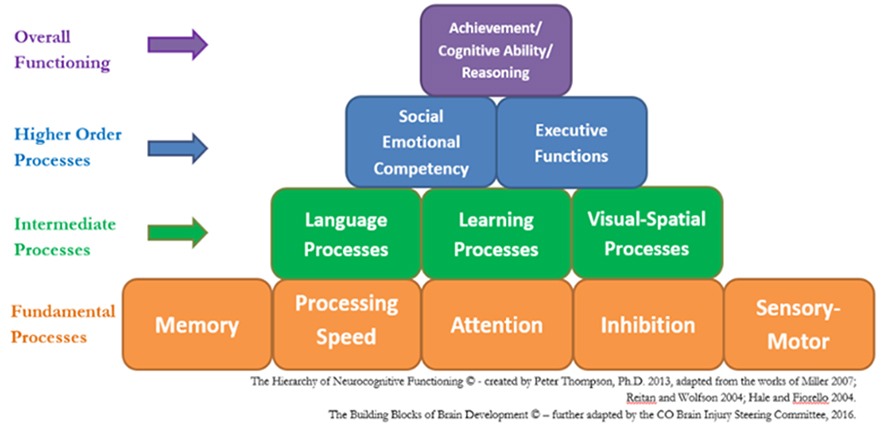 The graphic to the right represents the Building Blocks of Brain Development. Our brains develop each and every “building block” or brain function in a progressive manner. They build upon each other to become more complex (i.e., higher order thinking). The building blocks included here represent typical areas of processing/learning and those that are commonly affected by brain injury.